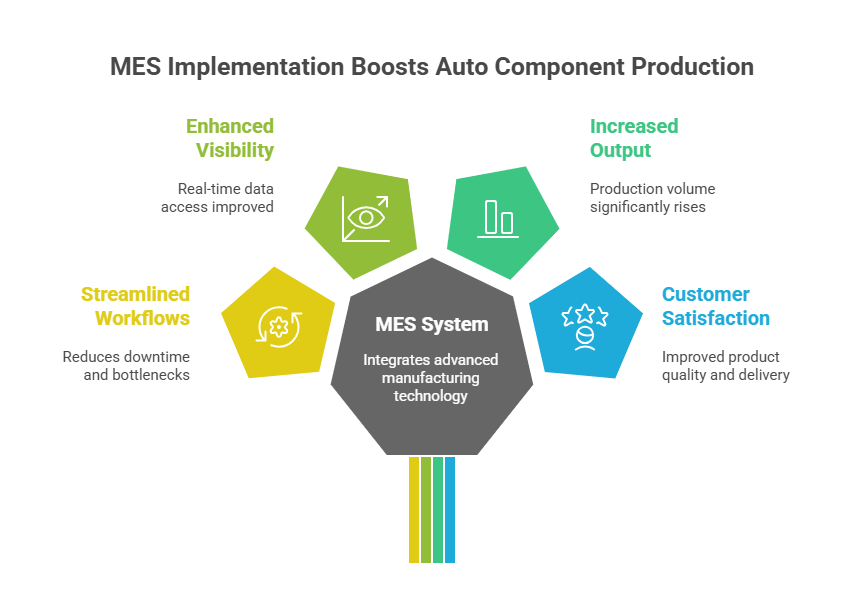
MES Implementation Story
Client Success Story: How an MES Implementation Transformed Auto Components
Introduction
Auto Components, a Tier-1 supplier for global automotive brands, had been growing rapidly. But with growth came challenges—frequent production delays, inconsistent quality, manual paperwork, and limited shop floor visibility were starting to impact customer commitments.
Their leadership team knew they needed a digital transformation, starting with a Manufacturing Execution System (MES).
This is the story of how we implemented DELMIA Apriso MES across their plant—and turned their operations into a high-performance, data-driven manufacturing engine.
1. The Problem: When Manual Processes Slow Down a Growing Factory
Operators recording production data manually
Frequent errors in batch and material tracking
No real-time visibility of machine status
Delayed decision-making due to late reporting
Difficulty meeting customer audit requirements
Lack of standardization across production lines
Every week, supervisors spent 8–10 hours reconciling mismatched numbers from physical logs, Excel sheets, and ERP reports.
The plant manager described it as:
“We were running a big plant with big ambitions—but using small tools.”
They needed a system that could scale → MES was the clear answer.
Operators recording production data manually
Frequent errors in batch and material tracking
No real-time visibility of machine status
Delayed decision-making due to late reporting
Difficulty meeting customer audit requirements
Lack of standardization across production lines
2. The Vision: A Connected, Paperless, High-Visibility Factory
Together, we defined a future state where:
Operators use intuitive digital screens
Supervisors track real-time WIP, scrap, and OEE
Machines send data directly to MES
ERP and MES exchange information seamlessly
Every part has full genealogy and traceability
The factory becomes audit-ready at any moment
Orion selected DELMIA Apriso (FlexNet) for its flexibility and global scalability.
Operators use intuitive digital screens
Supervisors track real-time WIP, scrap, and OEE
Machines send data directly to MES
ERP and MES exchange information seamlessly
Every part has full genealogy and traceability
The factory becomes audit-ready at any moment
3. The Implementation Journey
We spent two weeks interviewing operators, line leaders, quality teams, warehouse staff, and maintenance engineers.
We mapped over 48 processes, identifying bottlenecks and improvement opportunities.
We mapped over 48 processes, identifying bottlenecks and improvement opportunities.
B. Designing the TO-BE MES Blueprint
We created a future-ready design that included:
Apriso Production Module
Quality/Inspection workflows
Material & WIP movement tracking
Operator UI screens
Machine Integration Gateway
SAP-MES integration for orders & confirmations
Every process was simplified, standardized, and digitized.
Apriso Production Module
Quality/Inspection workflows
Material & WIP movement tracking
Operator UI screens
Machine Integration Gateway
SAP-MES integration for orders & confirmations
C. Development, Integration & Testing
We developed:
26 custom operator screens
14 machine data connectors
Real-time WIP dashboards
Digital quality inspection flows
Traceability from raw material to finished part
ERP (SAP) ➝ MES ➝ Machines formed a seamless digital thread.
26 custom operator screens
14 machine data connectors
Real-time WIP dashboards
Digital quality inspection flows
Traceability from raw material to finished part
D. Training & Go-Live
Before go-live, we conducted:
8 hands-on training workshops
Shift-level readiness sessions
Pilot runs on two lines
The go-live weekend was intense—but successful.
Within 48 hours, the entire plant moved from paper to digital workflows.
8 hands-on training workshops
Shift-level readiness sessions
Pilot runs on two lines
Within 48 hours, the entire plant moved from paper to digital workflows.
4. The Results: A Factory That Runs Smarter
After 3 months, Orion achieved measurable improvements:
Operational Improvements
31% reduction in manual data errors
22% increase in operator efficiency
18% decrease in unplanned downtime
100% real-time WIP visibility
31% reduction in manual data errors
22% increase in operator efficiency
18% decrease in unplanned downtime
100% real-time WIP visibility
Quality Gains
45% faster defect detection
Full traceability from material to shipment
Automated compliance reports
45% faster defect detection
Full traceability from material to shipment
Automated compliance reports
Business Impact
Faster customer audits
More accurate production planning
Better utilization of machines & operators
Stronger on-time delivery performance
Faster customer audits
More accurate production planning
Better utilization of machines & operators
Stronger on-time delivery performance
5. What Made This Project Successful?
Success Factors:
Clear leadership vision
Operator involvement from day one
Strong SAP integration
Scalable Apriso architecture
Agile implementation approach
Continuous improvement mindset
We also created a global MES template that Orion plans to roll out across its other plants next year.
Clear leadership vision
Operator involvement from day one
Strong SAP integration
Scalable Apriso architecture
Agile implementation approach
Continuous improvement mindset
6. Final Summary: A Story of Real Transformation
The Orion MES project proves one very important truth:
When technology, people, and processes work together, manufacturing can transform dramatically.
From manual logs to real-time dashboards, from data blindness to production clarity—MES helped Orion run a smarter, faster, and more efficient factory.
Today, Orion stands as a model for what a modern, connected manufacturing plant can achieve.

Leave a comment